
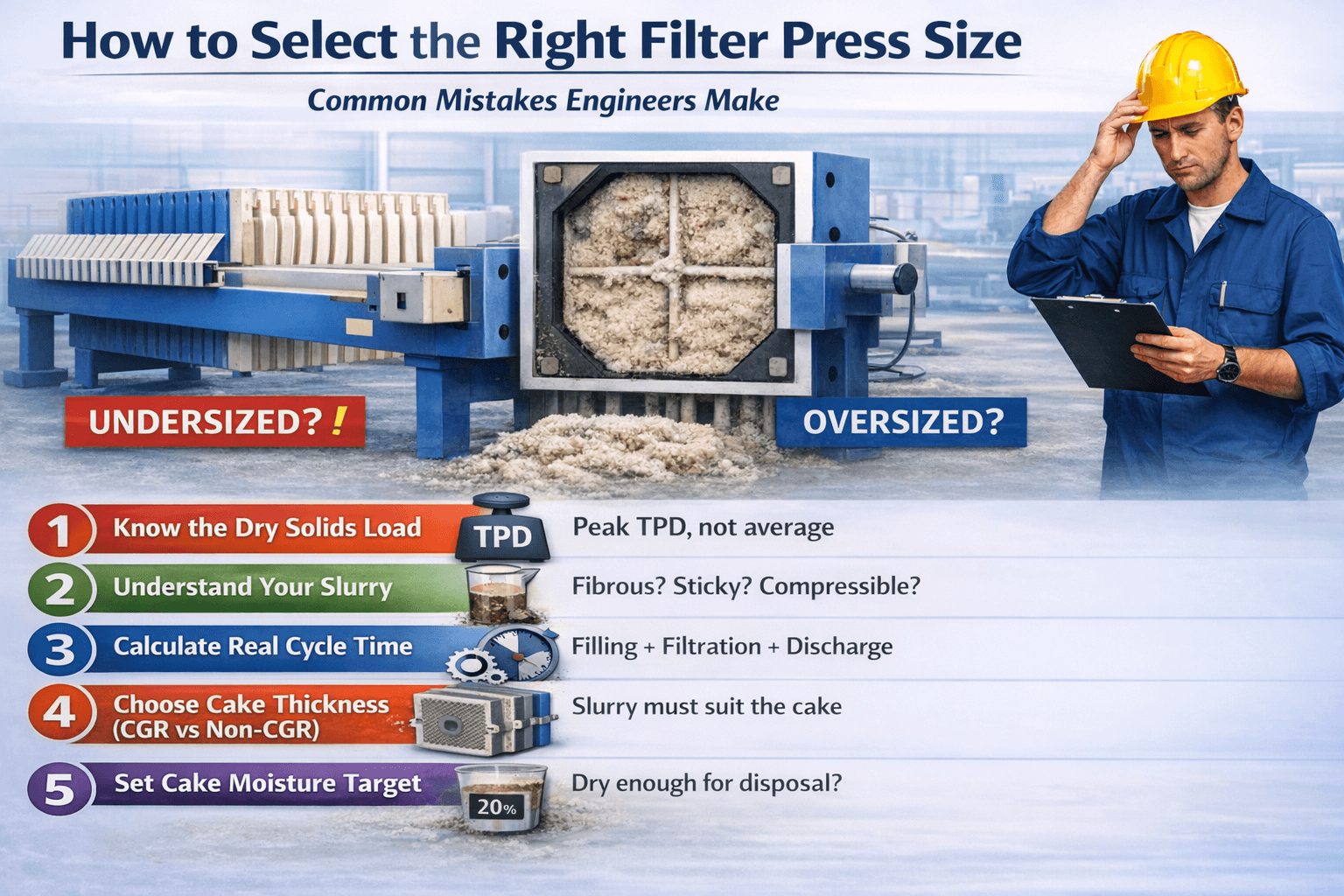
Select the Right Filter Press Size is one of the most critical decisions in any solid-liquid separation project. Yet, it is also one of the most commonly misunderstood aspects of filtration system design. A filter press that is undersized becomes a production bottleneck. An oversized filter press increases capital cost, occupies unnecessary space, and often operates inefficiently.
In this guide, we’ll break down how filter press sizing should actually be done-and the common mistakes engineers and buyers make while trying to select the right filter press size.
Why Filter Press Sizing Is Not Just About Plate Size
A very common misconception is:
“If solids load is high, just go for a bigger plate size.”
In reality, plate size alone does not define capacity. When you select the right filter press size, you must consider a combination of factors, including:
-
Solids load (TPD)
-
Slurry flow rate
-
Filtration cycle time
-
Cake thickness
-
Required cake moisture
-
Operating hours per day
Ignoring even one of these parameters can lead to serious operational issues later.
Step 1: Understand the Actual Solids Load
The dry solids per day (TPD) is the foundation of sizing. Many mistakes happen here, such as:
-
Using average solids instead of peak solids
-
Ignoring future expansion
-
Confusing wet cake quantity with dry solids
When you select the right filter press size, always base calculations on dry solids load and include a realistic margin for process variation and growth.
Step 2: Slurry Characteristics Matter More Than You Think
Not all slurries behave the same. Key slurry properties that affect sizing include:
-
Percentage of solids concentration
-
Particle size distribution
-
Compressibility of solids
-
Fibrous or sticky nature
For example, fibrous slurry like biomass requires more filtration area, while highly compressible sludge builds resistance faster, increasing cycle time. Trying to select the right filter press size without understanding slurry behavior is one of the biggest engineering mistakes.
Step 3: Cycle Time Is the Hidden Capacity Killer
Two filter presses with the same plate size and number of plates can have very different outputs if cycle time differs. Cycle time includes:
-
Filling time
-
Filtration time
-
Cake discharge time
-
Cloth washing, if any
A press designed for a 60-minute cycle behaves very differently from one running a 120-minute cycle. Engineers often calculate capacity assuming an ideal cycle time, which rarely happens in real plants. This is why real-world data is essential when you select the right filter press size.
Step 4: Cake Thickness (CGR vs Non-CGR)
Cake thickness directly impacts capacity.
-
Non-CGR recessed plates have fixed cake thickness
-
CGR (Cake Growth Ring) plates allow increased cake thickness and higher solids per cycle
A common mistake is choosing CGR plates without confirming whether the slurry can actually build a thicker cake, or using non-CGR plates where higher capacity is needed. The decision should always support the goal to select the right filter press size based on slurry dewaterability, not just theoretical numbers.
Step 5: Required Cake Moisture Is Often Ignored
Many designs focus only on throughput, not final cake moisture. Lower cake moisture usually means:
-
Longer filtration or squeezing time
-
Sometimes the need for membrane plates instead of standard plates
If cake moisture requirement is not considered during sizing, the filter press may meet TPD but still produce cake that is too wet for handling or disposal. This leads to dissatisfaction even when the press seems to be working. A proper approach to select the right filter press size must include moisture targets.
Step 6: Operating Hours Decide the Final Size
A 10 TPD solids load can be handled by:
-
A smaller press running 24 hours, or
-
A larger press running 10–12 hours
A frequent mistake is not clarifying plant operating hours upfront. This results in presses running continuously without buffer, no time for maintenance, and frequent breakdowns. To select the right filter press size, always include operational breathing space in your design.
Common Mistakes Engineers and Buyers Make
Let’s summarize the most frequent errors:
-
Selecting plate size based on past projects, not current slurry
-
Ignoring cycle time and cake discharge time
-
Confusing wet cake quantity with dry solids
-
Oversizing “to be safe” without ROI analysis
-
Not planning for future capacity increase
These mistakes often don’t show up during commissioning, but appear months later as production loss or high operating cost.
What a Correct Filter Press Sizing Approach Looks Like
A proper sizing exercise to select the right filter press size always includes:
-
Dry solids load (TPD)
-
Slurry flow rate and percentage solids
-
Cake moisture requirement
-
Expected cycle time
-
Operating hours per day
-
Plate type (CGR, non-CGR, or membrane)
Only after evaluating these parameters should plate size and number of plates be finalized.
Conclusion
Select the Right Filter Press Size is not just a design step-it is a strategic decision that affects productivity, operating cost, and long-term reliability. Most sizing problems come from oversimplification, wrong assumptions, or ignoring real process conditions.
By focusing on solids load, slurry behavior, cycle time, cake thickness, moisture targets, and operating hours, engineers can avoid costly mistakes and build a filtration system that performs efficiently for years to come.
If you want better performance without unnecessary cost, always start by learning how to select the right filter press size the right way.