
In real plant conditions, slurry filtration is rarely as simple as separating liquid from solids. Some slurries are easy to handle. Others clog cloths, form inconsistent cake, or take far too long to dewater. The difference between smooth operation and constant process frustration usually comes down to how well the filtration system matches the slurry itself.
This is why understanding how to filter industrial slurry efficiently matters so much. It is not about buying the most advanced machine. It is about making the right process decisions from the beginning.
Why Industrial Slurry Filtration Often Becomes a Bottleneck
In many facilities, slurry filtration is treated as a support function rather than a core process. That is usually a mistake.
When filtration is slow or inconsistent, the impact spreads across the plant. Tanks fill up, production slows down, operators spend more time on cleanup, and waste disposal costs increase. What starts as a filtration issue often turns into a production issue.
The reason this happens is simple. Slurry behavior changes from one application to another, and a filtration setup that works well for one material may perform poorly for another.
That is why plants that truly want to Filter Industrial Slurry Efficiently have to look beyond equipment labels and focus on process fit.
Step One: Understand the Slurry Before Choosing the System
The first and most important step is understanding the material you are trying to filter. This is where many problems begin.
Not all slurry behaves the same way. Some common characteristics that influence performance include:
-
Solid concentration
-
Particle size distribution
-
Compressibility of solids
-
Stickiness or fibrous content
-
Temperature and chemical composition
A fine, compressible slurry behaves very differently from a coarse, free-draining one. If you ignore this and choose equipment based only on capacity or budget, filtration efficiency usually suffers.
Plants that consistently Filter Industrial Slurry Efficiently almost always begin by analyzing the slurry properly, either through process data or pilot testing.
Choose the Right Filtration Technology
Once slurry behavior is understood, the next step is selecting the right filtration method. This decision has a direct effect on cycle time, cake dryness, labor, and maintenance.
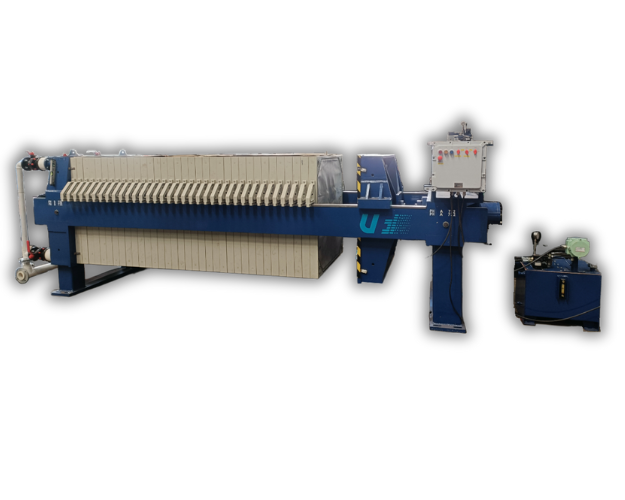
Filter Press
A filter press is often one of the most effective options when the goal is strong dewatering and manageable cake discharge. It works especially well for medium to high solids slurry and batch-based operations.
Membrane Filter Press
When better cake dryness is required, a membrane filter press can significantly improve results. It adds a squeezing stage after filtration, which helps remove additional moisture from the cake.
Vacuum Belt Filter
For continuous operations with steady slurry flow, vacuum belt filters may be more suitable. These systems are often used where throughput is more important than maximum dryness.
Pressure Leaf Filter
In applications where liquid clarity is more important than dry cake, pressure leaf filters can be a strong option.
The most efficient plants do not ask which machine is best in general. They ask which one helps them Filter Industrial Slurry Efficiently under their actual operating conditions.
Optimize Solids Concentration Before Filtration
One of the most practical ways to improve performance is to optimize the slurry before it even reaches the filtration equipment.
If the feed is too dilute, filtration becomes unnecessarily slow. If it is too thick, it may not flow properly or distribute evenly across the filter chambers.
In many cases, simple upstream adjustments such as settling, thickening, or controlled feed preparation can improve performance dramatically.
This is often overlooked, but it makes a major difference for plants trying to Filter Industrial Slurry Efficiently without increasing machine size or energy use.
Cycle Time Is Often the Hidden Problem
A common misconception is that filtration efficiency is only about how much water gets removed. In reality, cycle time matters just as much.
If a filter press takes too long to fill, too long to dewater, or too long to discharge, the whole process becomes inefficient even if the final cake looks acceptable.
Efficient slurry filtration requires balancing:
-
Filling time
-
Filtration time
-
Cake discharge time
-
Cloth cleaning time
Plants that monitor and optimize these stages usually see better throughput without needing new equipment.
This is one of the most practical ways to Filter Industrial Slurry Efficiently in an existing setup.
Cloth Selection and Maintenance Matter More Than Most People Realize
Filter cloth is often treated like a small detail, but it has a huge impact on performance.
The wrong cloth can cause:
-
Slow filtration
-
Poor filtrate clarity
-
Frequent clogging
-
Uneven cake formation
Even the right cloth performs poorly if it is not cleaned or maintained properly.
In real-world plant operation, many filtration issues are not caused by the machine itself. They come from cloth selection, cloth blinding, or neglected maintenance.
If you want to Filter Industrial Slurry Efficiently, filter media should never be treated as an afterthought.
Pressure Control Makes a Real Difference
Applying more pressure does not always mean better filtration. In fact, too much pressure can compress the cake too quickly, making it harder for liquid to escape.
This is especially true for compressible or fine-particle slurries.
Efficient filtration often depends on applying the right pressure at the right stage, not simply maximizing force from the start.
Plants that control pressure properly usually achieve more stable cycles, better cake quality, and lower energy consumption.
Real-World Example: Same Equipment, Better Process
Consider a wastewater treatment plant using a standard filter press. Their main complaint is long cycle time and wet cake.
Instead of replacing the machine, they review the process and make three changes:
-
Increase solids concentration before filtration
-
Change the filter cloth to a more suitable grade
-
Adjust feed pressure and cycle timing
The result is shorter cycles, drier cake, and lower labor time.
This is a good reminder that to Filter Industrial Slurry Efficiently, process optimization often matters just as much as equipment selection.
Common Mistakes That Reduce Filtration Efficiency
A few recurring mistakes appear in many plants:
-
Choosing equipment without slurry testing
-
Using the wrong filter cloth
-
Ignoring feed consistency
-
Running longer cycles than necessary
-
Failing to clean or maintain the system regularly
These issues may seem small individually, but together they can significantly reduce filtration efficiency and increase cost.
Final Thoughts
Filter Industrial Slurry Efficiently is not about chasing the most expensive technology or the most complex setup. It is about understanding the slurry, selecting the right filtration method, and optimizing the process around real operating conditions.
When done correctly, efficient slurry filtration improves far more than separation. It supports smoother plant operation, lower waste handling costs, better product recovery, and stronger long-term process reliability.
For any industry handling slurry on a regular basis, getting this part of the process right is not just useful. It is essential.