
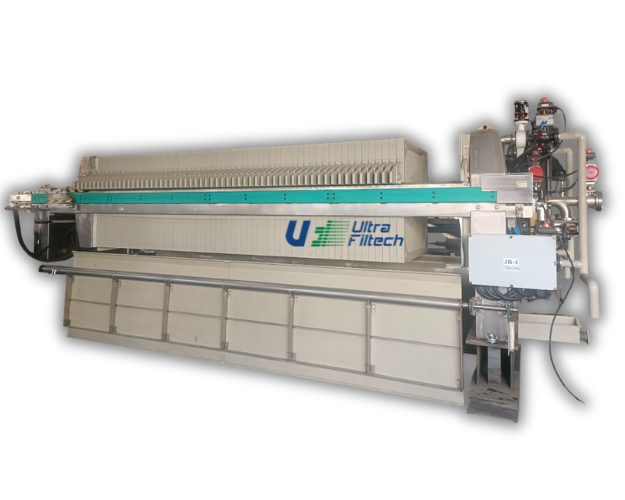
What Is a Fully Automatic Filter Press?
A Fully Automatic Filter Press is a filtration machine equipped with hydraulic systems, automatic plate shifting mechanisms, and programmable controls. Unlike manual or semi-automatic filter presses, this system performs most operational steps automatically.
The goal of a fully automatic filter press is to:
-
Increase throughput
-
Reduce manual labor
-
Improve operational safety
-
Deliver consistent cake quality
-
Optimize cycle time
It is commonly used in medium to large-scale industrial operations where efficiency and reliability are critical.
Main Components of Fully Automatic Filter Press
A Fully Automatic Filter Press consists of several integrated components:
-
Filter plates and chambers for slurry separation
-
Filter cloth for solid retention
-
Hydraulic closing system for uniform pressure
-
Automatic plate shifting device
-
PLC-based control panel for cycle automation
-
Feed pump for slurry input
-
Optional cloth washing system
-
Structural support frame
Each component works together to ensure smooth and repeatable filtration cycles.
How Fully Automatic Filter Press Works
The working cycle of a Fully Automatic Filter Press follows a structured and automated sequence:
1. Automatic Plate Closing
The hydraulic system closes the plate pack with uniform pressure, forming sealed chambers for filtration.
2. Controlled Slurry Feeding
Slurry is pumped into the chambers. Liquid passes through the filter cloth and exits as filtrate, while solids remain inside, forming a filter cake.
3. Cake Formation and Filtration
As filtration continues, cake thickness increases. The system monitors pressure and flow rate to determine when the filtration stage is complete.
4. Automatic Cake Discharge
Once filtration ends, the fully automatic filter press opens the plates one by one. The cake drops automatically, minimizing manual intervention.
5. Optional Cloth Washing
Some systems include automatic cloth washing to maintain filtration efficiency and extend cloth life.
After discharge, the press closes again and starts the next cycle automatically.
Advantages of Fully Automatic Filter Press
Using a Fully Automatic Filter Press offers multiple benefits:
-
Significant reduction in labor cost
-
Faster and consistent cycle time
-
Improved safety with less manual handling
-
Higher daily throughput
-
Better control over filtration parameters
-
Lower long-term operating cost
These advantages make it a cost-effective solution for high-volume operations.
Applications of Fully Automatic Filter Press
A Fully Automatic Filter Press is widely used in industries such as:
-
Chemical and petrochemical processing
-
Pharmaceutical manufacturing
-
Mining and mineral processing
-
Food and beverage production
-
Dyes and pigments
-
Effluent and wastewater treatment
Any process requiring reliable and continuous solid–liquid separation can benefit from this system.
Fully Automatic Filter Press vs Manual Filter Press
Compared to manual systems, a Fully Automatic Filter Press offers:
-
Higher productivity
-
Lower manpower requirement
-
Better consistency
-
Reduced downtime
-
Improved overall efficiency
While manual presses are suitable for small operations, fully automatic systems are better for large-scale and continuous production environments.
When Should You Choose a Fully Automatic Filter Press?
A Fully Automatic Filter Press is ideal when:
-
Daily filtration volume is high
-
Labor cost is significant
-
Consistent performance is required
-
Plant operates multiple shifts
-
Long-term cost reduction is a priority
In such scenarios, the higher initial investment is justified by operational savings.
Maintenance and Best Practices
To ensure long-term performance of a Fully Automatic Filter Press:
-
Regularly inspect filter cloth
-
Maintain hydraulic systems properly
-
Monitor control panel settings
-
Follow preventive maintenance schedules
-
Ensure proper plate alignment
Good maintenance reduces unexpected downtime and maximizes return on investment.
Conclusion
Fully Automatic Filter Press is a modern and efficient solution for industries that demand high productivity, consistent performance, and lower operating cost. By automating the entire filtration cycle, it reduces labor dependency, improves safety, and increases plant efficiency.
If your filtration process requires reliable, high-capacity solid–liquid separation with minimal manual effort, investing in a Fully Automatic Filter Press is a smart and future-ready decision.