
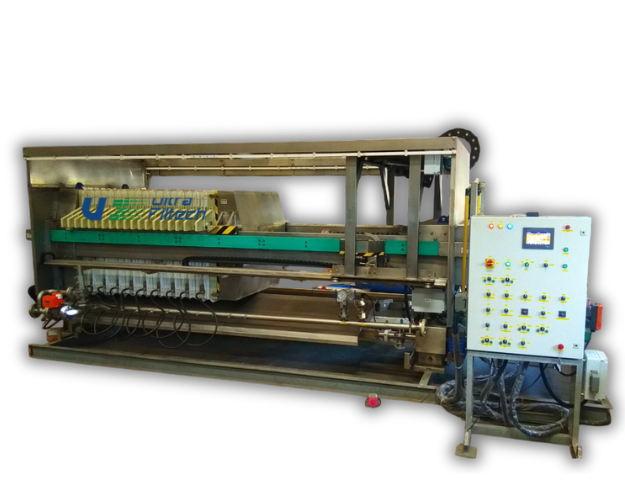
This guide explains why a membrane filter press gives better cake dryness, how the process works, and what practical benefits industries gain from this improved performance.
Why Cake Dryness Matters in Filtration
Cake dryness is not just a quality parameter. It has a direct impact on operating cost and plant efficiency. Wetter cakes mean:
-
Higher transport and disposal cost
-
More energy required for drying or further processing
-
Difficult handling and storage
-
Lower overall process efficiency
A Membrane Filter Press is designed specifically to address these issues by pushing dewatering beyond the limits of normal filtration.
How Conventional Filter Press Dewatering Works
In a standard filter press, slurry is pumped into chambers and liquid passes through the filter cloth while solids form a cake. As the cake becomes thicker, resistance to flow increases. At a certain point, even high pressure cannot remove much more liquid because the pores in the cake are already highly resistant.
This is the natural limitation of filtration-only dewatering. Without additional mechanical force, the remaining moisture stays trapped inside the cake structure.
How Membrane Filter Press Improves Cake Dryness
The key difference with a Membrane Filter Press is the membrane squeezing stage. After the normal filtration step is completed, the membranes inside the plates are inflated using air or water pressure. This causes the flexible membrane surface to press directly against the filter cake.
This mechanical compression:
-
Reduces the void spaces inside the cake
-
Forces out trapped liquid that filtration alone cannot remove
-
Breaks capillary forces holding moisture in the cake
-
Creates a denser and drier cake structure
Because of this extra step, a membrane filter press can achieve much lower final cake moisture than a conventional system.
Uniform Pressure Distribution Makes a Big Difference
Another reason a Membrane Filter Press gives better cake dryness is uniform pressure distribution. In conventional presses, pressure is applied mainly through the slurry feed and is not always evenly distributed across the cake.
In a membrane system, the inflated membrane applies pressure directly and evenly over the entire cake surface. This uniform compression ensures:
-
More consistent dewatering across all chambers
-
Fewer wet spots inside the cake
-
More predictable and repeatable results from cycle to cycle
Consistency is a major advantage in industrial operations where stable performance is critical.
Better Performance With Compressible Slurries
Many industrial slurries, such as chemical sludge, mining tailings, or biological waste, are highly compressible. These materials quickly form a dense layer that blocks further filtration. In such cases, increasing filtration pressure alone does not significantly improve dryness.
A Membrane Filter Press overcomes this limitation by mechanically squeezing the cake. Even when the cake structure becomes highly resistant to flow, the squeezing action can still push out additional liquid, making membrane systems especially effective for difficult and compressible slurries.
Shorter Cycle Time With Better Results
It may sound counterintuitive, but a Membrane Filter Press often achieves better cake dryness in less total time. Instead of extending the filtration phase for marginal moisture reduction, the process shifts to a short, high-efficiency squeezing stage.
This approach:
-
Reduces unnecessary filtration time
-
Improves overall cycle efficiency
-
Increases daily throughput
-
Delivers drier cake without longer cycles
Better dryness with optimized cycle time means lower cost per ton of solids processed.
Lower Energy and Handling Costs
Drier cake from a Membrane Filter Press brings several downstream cost benefits:
-
Less energy needed for thermal drying or further processing
-
Lower transportation cost due to reduced weight
-
Lower disposal cost, especially where fees depend on moisture content
-
Easier handling and storage of solid waste
Over time, these savings often exceed the additional investment cost of membrane technology.
Improved Filtrate Quality and Process Stability
In many applications, the squeezing step in a Membrane Filter Press also improves filtrate clarity. As the cake is compressed, fine particles are held more tightly in the cake structure, reducing solids leakage and improving overall separation quality.
This leads to:
-
More stable process performance
-
Better compliance with discharge or reuse standards
-
Less reprocessing or polishing filtration required
Common Misconceptions About Membrane Filter Press
Some users assume that higher feed pressure alone can achieve the same dryness. In reality, once filtration reaches its natural limit, more pressure only increases energy use and equipment stress without significantly improving moisture removal.
The real advantage of a Membrane Filter Press comes from the mechanical squeezing action, not just higher filtration pressure.
When Does a Membrane Filter Press Make the Most Sense?
A Membrane Filter Press is especially beneficial when:
-
Disposal or transport cost depends on cake moisture
-
Slurry is compressible or difficult to dewater
-
High dryness is required for downstream processing
-
Energy and operating cost optimization is a priority
-
Plant wants higher throughput with better cake quality
In such cases, the improved cake dryness delivers both technical and economic advantages.
Conclusion
Membrane Filter Press technology gives better cake dryness because it goes beyond simple filtration and adds a powerful mechanical squeezing step. This combination of filtration and compression removes more moisture, improves consistency, shortens effective cycle time, and reduces downstream costs.
If your process is limited by wet cake, high disposal cost, or inefficient dewatering, upgrading to a Membrane Filter Press can be one of the most effective ways to improve performance and reduce total operating cost while achieving reliably drier filter cake.