
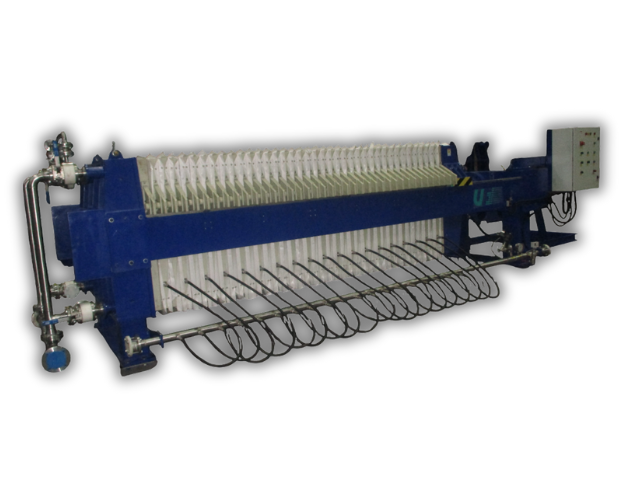
In this guide, you will learn what a membrane filter press is, how it works step by step, and why it is widely used in demanding industrial filtration applications.
What is a Membrane Filter Press?
Membrane Filter Press is a type of filter press that uses special membrane plates instead of standard recessed plates. These membrane plates have flexible membranes that can be inflated using air or water pressure after the filtration stage.The purpose of this design is to squeeze the filter cake after it has formed, removing additional moisture that a conventional filter press cannot easily remove. This results in drier cake, shorter cycle times, and better overall efficiency.
How Membrane Filter Press Works: Step-by-Step Process
The working principle of a Membrane Filter Press can be divided into several clear stages.
1. Plate Closing
The cycle begins with the filter plates being closed using a hydraulic system. This creates sealed chambers between the plates where the slurry will be fed.
2. Slurry Feeding
Slurry is pumped into the chambers under pressure. The liquid passes through the filter cloth and exits as filtrate, while solids are retained inside the chambers. At this stage, a filter cake starts forming on the cloth surface.
3. Cake Formation
As filtration continues, more solids accumulate and the cake becomes thicker. The Membrane Filter Press operates like a conventional filter press during this phase, relying on pressure to separate liquid from solids.
4. Membrane Squeezing Stage
Once the chambers are full and filtration slows down, the key advantage of the Membrane Filter Press comes into play. The membranes inside the plates are inflated using compressed air or water. This inflation presses the membrane against the filter cake, squeezing out additional liquid.
This step significantly reduces cake moisture and improves dewatering efficiency compared to standard filter presses.
5. Pressure Holding and Final Dewatering
The squeezing pressure is held for a set time to allow maximum liquid removal. This stage ensures that the cake reaches the desired dryness level before discharge.
6. Plate Opening and Cake Discharge
After squeezing is complete, the plates are opened and the dry filter cake is discharged. The system is then ready for the next filtration cycle.
Why Membrane Filter Press Produces Drier Cake
The main reason a Membrane Filter Press produces drier cake is the additional mechanical compression provided by the membrane. In a conventional filter press, dewatering stops once flow resistance becomes too high. In a membrane system, the cake is physically compressed, forcing more liquid out even after normal filtration has slowed down.
This results in:
-
Lower final cake moisture
-
Better cake handling and transport
-
Reduced disposal cost
-
Improved overall process efficiency
Key Advantages of Membrane Filter Press
Using a Membrane Filter Press offers several important benefits:
-
Shorter filtration cycles due to faster dewatering
-
Lower energy consumption per ton of solids processed
-
Reduced operating cost because of drier cake
-
Higher throughput with the same filtration area
-
Better performance with difficult or compressible slurries
These advantages make membrane systems especially attractive for industries where moisture content and disposal cost are critical factors.
Industries That Use Membrane Filter Press
A Membrane Filter Press is commonly used in industries such as:
-
Chemical and petrochemical processing
-
Pharmaceuticals and fine chemicals
-
Mining and mineral processing
-
Dyes and pigments
-
Effluent and wastewater treatment
-
Food and beverage processing
Any process that benefits from lower cake moisture and higher filtration efficiency can gain value from this technology.
Membrane Filter Press vs Conventional Filter Press
Compared to a standard filter press, a Membrane Filter Press offers:
-
Better dewatering performance
-
Shorter overall cycle time
-
Lower cake moisture
-
Higher capital cost but lower operating cost over time
For many plants, the long-term savings in energy, handling, and disposal more than justify the initial investment.
Important Factors to Consider When Using Membrane Filter Press
To get the best results from a Membrane Filter Press, it is important to consider:
-
Slurry compressibility and particle size
-
Required final cake moisture
-
Suitable squeezing pressure
-
Cycle time optimization
-
Proper maintenance of membranes and cloths
Correct process tuning ensures consistent performance and long service life.
Common Mistakes in Membrane Filter Press Operation
Some common mistakes include:
-
Using excessive squeezing pressure, which can damage membranes
-
Ignoring slurry variability, leading to inconsistent results
-
Not optimizing cycle time, which reduces productivity
-
Poor maintenance of filter cloth and membranes
Avoiding these issues helps maintain stable and cost-effective operation.
Conclusion
Membrane Filter Press technology adds a powerful squeezing step to conventional filtration, making it one of the most efficient solutions for solid-liquid separation. By understanding how it works and how to operate it correctly, industries can achieve drier cake, lower operating costs, and higher overall productivity.
If your process demands better dewatering, faster cycles, and improved filtration economics, investing in a Membrane Filter Press can be a smart and future-ready decision.